
Bladder and Bowel Anxiety Program: Support for Incontinence and Stoma-Related Worries
.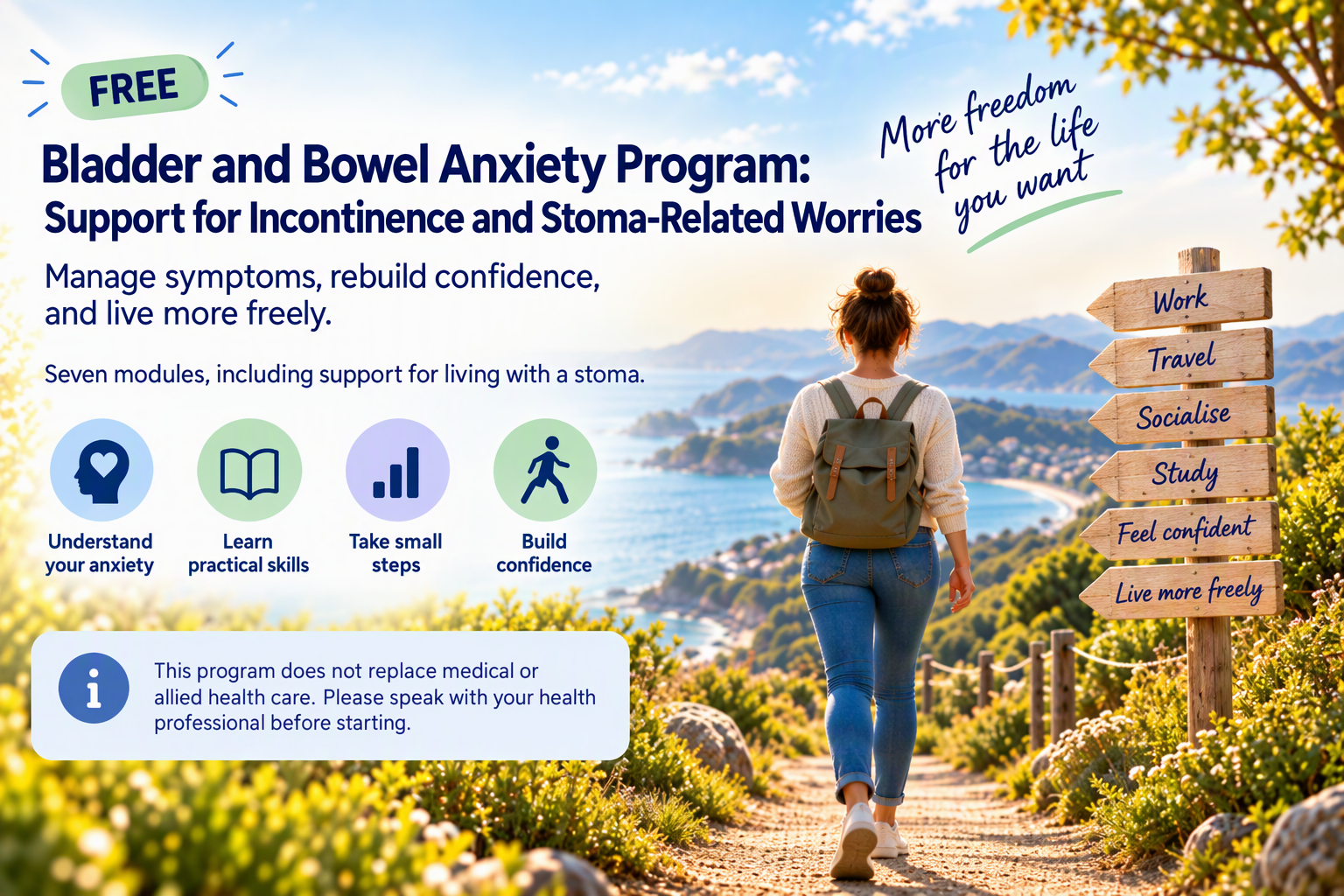
Manage Symptoms, Rebuild Confidence, and Live More Freely
Living with bladder or bowel incontinence or a stoma can make everyday activities feel stressful, unpredictable, or limiting, particularly when you worry about urgency, leakage, pouch leaks, or having an accident. Incontinence-related anxiety can occur alongside actual leakage or even when an accident is unlikely, and may lead to constant monitoring, extensive preparation, avoidance, shame, and reduced confidence.
This free, evidence-informed program is designed to help you understand how anxiety interacts with bladder or bowel symptoms and stoma-related concerns, respond appropriately to your continence and stoma-care needs, and take practical, step-by-step action towards greater confidence, participation, and quality of life.
The program is organised as a seven-module, self-guided intervention. It takes a transdiagnostic approach: rather than focusing on one diagnostic label or cause of incontinence, it targets common psychological processes that maintain anxiety, whether your concerns relate to the bladder, the bowel, or both, and whether you have had frequent leakage, occasional accidents, or only the fear of one, and whether you live with a stoma and worry about pouch leaks, noise, or smell. It combines education about the brain–bladder–bowel connection with cognitive, attentional, behavioural, acceptance-based, self-compassion, and graded exposure strategies. Activities can be adapted to your symptoms, practical continence and stoma-care needs, healthcare advice, personal goals, and circumstances.
This program is not a replacement for medical and allied health support:
This free online program offers general education and self-help support. It does not replace medical, psychological, physiotherapy, or other allied health care. If you have concerns about your physical or mental health, or are unsure whether the program is suitable for you, please speak with your medical practitioner or allied health team before starting. This self-guided program is not suitable for people experiencing severe mental illness. If you are seeing or hearing things that others do not, feel that others are trying to harm you or that you need to remain constantly on guard, or are having thoughts of harming yourself, please seek support from a health professional promptly rather than relying on this program. If you need immediate help or feel unable to stay safe, seek emergency medical care.
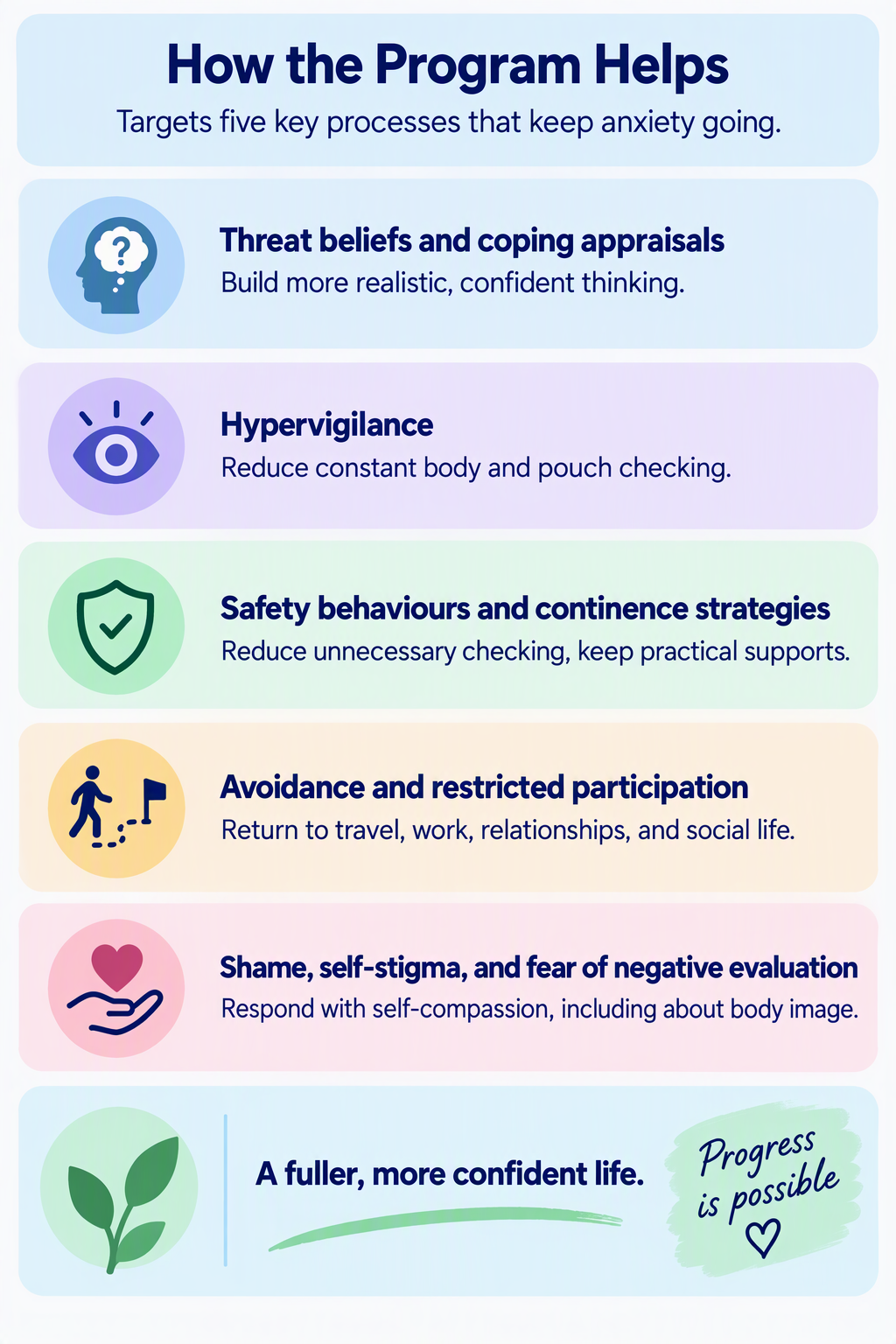
How the Program Helps
Across all modules, the program targets five core anxiety-maintaining processes while supporting practical, person-centred management of actual bladder or bowel incontinence, including living with a stoma:
- Threat beliefs and coping appraisals: overestimating the likelihood or impact of an accident, or underestimating the ability to cope
- Hypervigilance: constant monitoring of urgency, sensations, a stoma pouch, and possible leakage
- Safety behaviours and continence-management strategies: reducing excessive checking, preventive toileting, or reassurance while retaining proportionate practical supports
- Avoidance and restricted participation: gradually re-engaging with travel, work, relationships and intimacy, social activities, and other valued situations using realistic planning
- Shame, self-stigma, and fear of negative evaluation: responding compassionately to actual or feared leakage, including worries about body image, and strengthening confidence in coping
By working on these processes directly, you can learn to assess risk more realistically, use practical supports proportionately, reduce unnecessary restriction, and participate more fully even when some symptoms or uncertainty remain.
A Practical, Person-Centred Approach
This program recognises that bladder, bowel, and stoma-related concerns are not always driven by anxiety. It helps you distinguish practical continence and stoma-care needs from anxiety-related patterns that heighten fear, excessive monitoring, shame, reliance on safety behaviours, and avoidance. It encourages appropriate medical, continence, and stoma-care assessment while helping you change patterns that unnecessarily restrict your life.
It combines:
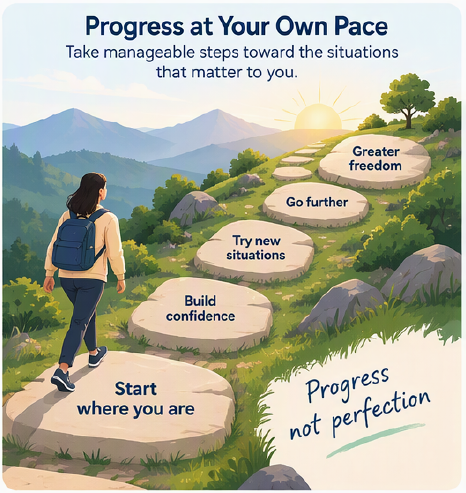
The program is flexible and self-guided, allowing you to move at your own pace and tailor strategies to your specific experiences and goals.
Program Structure and Time Commitment
What You’ll Learn
Across seven modules, you will build practical skills to:
- Understand incontinence- and stoma-related anxiety, alongside the brain–bladder–bowel connection.
- Assess threat beliefs and catastrophic predictions about leakage, accidents, pouch leaks, noise, or smell more realistically.
- Respond to genuine bodily cues and stoma-care needs without becoming consumed by monitoring or repeated pouch checking.
- Distinguish proportionate continence and stoma-care supports from anxiety-maintaining safety behaviours.
- Respond to shame, uncertainty, symptoms, leakage or pouch leaks, and setbacks with greater self-compassion and flexibility
- Use graded, risk-informed exposure and behavioural experiments to rebuild participation while respecting continence and stoma-care needs.
- Maintain progress and develop a long-term plan for managing bladder, bowel, or stoma-related concerns and preventing a return to anxiety-driven patterns.
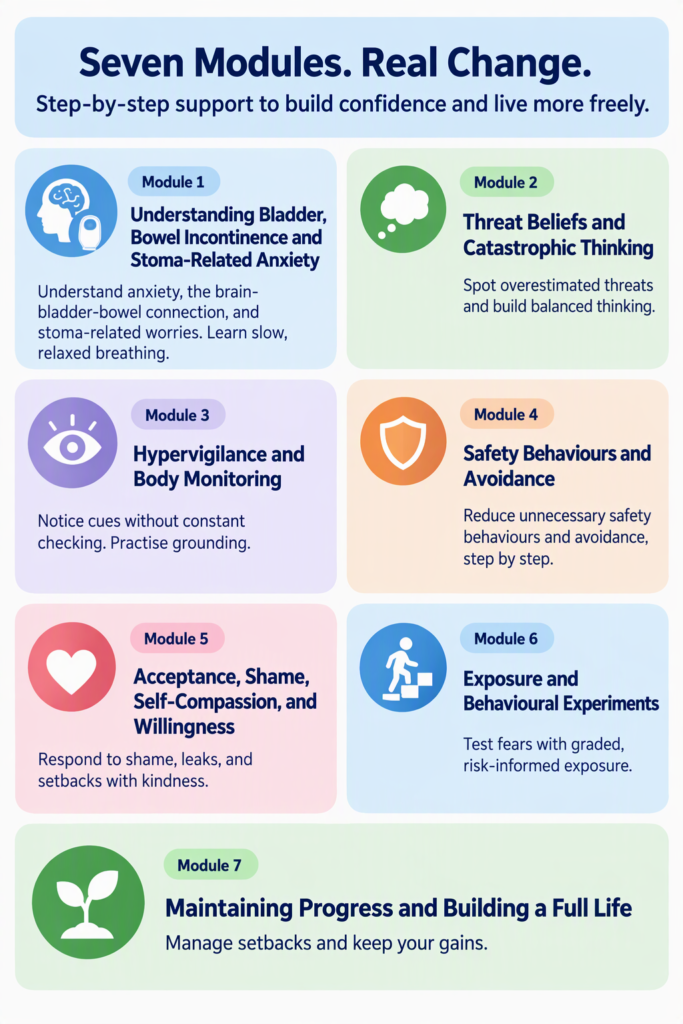
Overview of the program modules
Module 1. Understanding Bladder and Bowel Incontinence Anxiety
Understand bladder and bowel incontinence, incontinence-related anxiety, and how anxiety may occur with or without actual leakage, including similar worries about pouch leaks, noise, or smell for people with a stoma. Explore the brain–bladder–bowel connection, how the nervous system responds to anxiety, the anxiety-maintenance cycle, and your own symptom patterns, triggers, avoidance, practical continence needs, and quality-of-life impacts alongside appropriate medical or continence assessment. You will also learn slow relaxed breathing, a first practical skill for settling the body’s anxiety response.
Module 2. Threat Beliefs and Catastrophic Thinking
Identify common predictions such as “I will have an accident”, “Everyone will notice”, or “I won’t cope”. Learn about catastrophising, probability overestimation, and emotional reasoning; distinguish realistic risk and practical preparation from anxiety-driven restriction; and develop more balanced ways of thinking about uncertainty and bodily sensations.
Module 3. Hypervigilance and Body Monitoring
Distinguish helpful awareness of bladder or bowel cues from excessive monitoring, including repeated pouch checking, that amplifies distress and urgency. Explore selective attention and symptom scanning, then practise mindfulness, grounding, and attention broadening to shift your focus from internal monitoring to the task and the environment, without ignoring genuine cues.
Module 4. Safety Behaviours and Avoidance
Distinguish adaptive continence and stoma-management strategies from excessive or rigid safety behaviours, such as repeated pouch checking or carrying far more supplies than needed. Examine how avoidance limits corrective learning and quality of life, then develop a gradual plan to reduce unnecessary strategies while retaining proportionate supports recommended by healthcare, continence, or stoma care professionals.
Module 5. Acceptance, Shame, Self-Compassion, and Willingness
Understand shame, embarrassment, fear of negative evaluation (including worries about body image), and the effects of self-criticism. Build a kinder response to leakage, pouch leaks, accidents, symptom flares, and setbacks while developing values, psychological flexibility, acceptance, and willingness to experience uncertainty or discomfort in valued situations.
Module 6. Exposure and Behavioural Experiments
Use graded, risk-informed exposure to reduce fear and rebuild participation while respecting genuine continence needs and medical advice, with guidance for people with a stoma on testing fears about pouch leaks, noise, and smell. Develop an individual hierarchy, test feared predictions and coping beliefs without creating unnecessary risk, and learn from experience rather than seeking reassurance.
Module 7. Maintaining Progress and Building a Full Life
Learn to respond to anxiety setbacks, leakage episodes (including pouch leaks), and symptom flares without abandoning valued activities or returning to broad avoidance. Recognise how stress and physical factors can affect symptoms, know when to seek professional review, maintain exposure gains, and build a personal resilience toolbox along with a long-term confidence, symptom-management, relapse-prevention, and support plan.
What You Can Expect
With regular practice, many people experience:
- Less anxiety-driven avoidance and greater participation in valued activities
- More balanced responses to urgency, bodily sensations, uncertainty, and feared accidents
- Reduced hypervigilance, shame, and reliance on excessive safety behaviours
- Greater confidence using proportionate continence and stoma supports at work, while travelling, and in social settings
- A clearer plan for managing symptoms, setbacks, and future challenges
Progress is gradual and does not require perfect continence or complete certainty. Meaningful change involves responding effectively to symptoms, using supports proportionately, and continuing to move towards what matters.
A Supportive Starting Point
This program is designed to complement professional care. Because bladder and bowel function can be affected by medical factors, an appropriate medical or continence assessment is recommended before starting, for example with a medical doctor, urologist, gastroenterologist, colorectal surgeon, continence nurse, stoma nurse, pelvic floor physiotherapist, and/or psychologist. If you have a stoma, it is also worth having your stoma care and pouch fit reviewed, so that practical causes of leakage are addressed alongside the anxiety. Seek advice if you have pain, blood in urine or stool, recurrent urinary infections, severe constipation, new or worsening leakage, a sudden change in bladder or bowel control, difficulty emptying your bladder or bowel, neurological symptoms, changes in how your stoma looks, skin irritation or breakdown around your stoma, a pouch that repeatedly leaks or no longer fits well, or concerns about whether these activities are appropriate for you. Please also discuss any changes to toileting routines, fluid or food intake, continence supports, or stoma supplies with your healthcare, continence, or stoma care professional before trying them.
Incontinence Anxiety Resources
The organisations below provide information and support on bladder and bowel incontinence, and on living with a stoma, in Australia, Great Britain, and the United States. They can complement this program, but they do not replace assessment and care from your medical practitioner or an appropriately qualified continence, stoma care, or pelvic health professional.
Australia
- Continence Health Australia
National Continence Helpline
- Victorian State Government – Better Health Channel
Incontinence and continence health
- National Ageing Research Institute – Massive Open Online Course (MOOC) on ‘Caregiving, Dementia and Incontinence’ for family and professional carers of people living with dementia and continence care needs
Caregiving, Dementia and Incontinence
- Australian Council of Stoma Associations
Stoma associations, living well with a stoma, and the Stoma Appliance Scheme
- Australian Association of Stomal Therapy Nurses
Find a stomal therapy (stoma) nurse
Great Britain
- International Continence Society
International Continence Society
- Bladder & Bowel UK
Bladder & Bowel UK
- National Health Service (NHS) – Urinary Incontinence
Urinary incontinence
- National Health Service (NHS) – Bowel Incontinence
Bowel incontinence
- Colostomy UK
Stoma helpline, information, and support
- Ileostomy & Internal Pouch Association (IA)
Support for people with an ileostomy or internal pouch
- The Urostomy Association
Support for people with a urinary diversion or urostomy
United States
- National Association for Continence
National Association for Continence
- National Institutes of Health
Urinary Incontinence in Older Adults
- United Ostomy Associations of America
Ostomy support, education, and support group finder
The information provided by these organisations should complement—not replace—individualised medical, continence, stoma care, pelvic health, or psychological care.
How to access the free program?
Use the following credentials:
Username: BBAresilience
Password: BBAaccess
Please note: If you have bladder, bowel, mental health, or other health concerns, or if you are unsure whether this program is suitable for you, please speak with your medical practitioner or allied health team before using it. This is especially important if you have new, worsening, or unexplained symptoms, or if you are currently receiving care for a related physical or mental health condition.